Waiting until a container hits staging or production to scan for CVEs, leaked tokens, or broken code slows everyone down. Fixing a vulnerability right after git push takes minutes; tracking it down three weeks later in a release branch takes days.
The bigger trap in many CI/CD setups is security theater: adding scanners that run in allow_failure: true mode forever, or pasting long-lived registry passwords and kubeconfigs into GitLab CI project variables. Here is how to wire SonarQube (SAST), Trivy (secret scan, CVE gate, and CycloneDX SBOM), and HashiCorp Vault (short-lived OIDC/JWT secrets) into one clean GitLab CI pipeline.
1. Pipeline Architecture
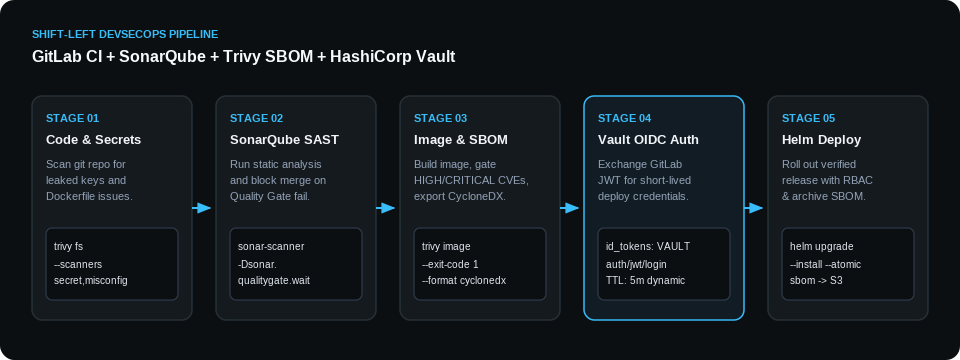
Each stage has one clear job:
- Repo & Secret Scan: Catch hardcoded API keys or insecure Dockerfiles before running heavy builds.
- SonarQube SAST: Run static code analysis and wait for the Quality Gate result.
- Container Build, CVE Gate & SBOM: Build the image, block
HIGH/CRITICALOS or library CVEs with a known fix, and emit a CycloneDX SBOM artifact. - Vault JWT Auth: Exchange GitLab’s signed
id_tokensJWT for short-lived Vault credentials instead of storing static tokens. - Helm Deploy: Ship the verified image tag to Kubernetes with
--atomicrollback protection.
2. Configure HashiCorp Vault JWT Auth for GitLab CI
GitLab CI issues signed OIDC tokens via id_tokens. HashiCorp Vault can verify those tokens directly against GitLab’s JWKS endpoint, so your pipeline never needs a static VAULT_TOKEN.
Enable and configure the JWT auth backend in Vault:
vault auth enable jwt

vault write auth/jwt/config \
  jwks_url="https://gitlab.example.com/-/jwks" \
  bound_issuer="https://gitlab.example.com"
Create a least-privilege policy (gitlab-deploy-policy.hcl) allowing read access only to the target service’s KV path:
path "kv/data/prod/my-service/*" {
  capabilities = ["read"]
}gitlab-deploy-policy.hcl
Apply the policy and bind a Vault role strictly to your GitLab project and protected main branch:
vault policy write gitlab-deploy gitlab-deploy-policy.hcl

vault write auth/jwt/role/gitlab-ci-deploy \
  role_type="jwt" \
  policies="gitlab-deploy" \
  token_explicit_max_ttl="5m" \
  user_claim="user_login" \
  bound_claims_type="glob" \
  bound_claims='{
    "project_path": "platform/my-service",
    "ref": "main",
    "ref_type": "branch"
  }'
Notice token_explicit_max_ttl="5m" and bound_claims: even if someone forks the repo or runs a pipeline from a feature branch, Vault refuses to issue production secrets.
3. SonarQube SAST & Quality Gate
Add a sonar-project.properties file in your repository root so scanner settings stay versioned alongside the code:
sonar.projectKey=platform_my-service
sonar.projectName=my-service
sonar.sources=src
sonar.tests=tests
sonar.sourceEncoding=UTF-8sonar-project.properties
In CI, pass -Dsonar.qualitygate.wait=true. Without that flag, sonar-scanner submits the report and exits 0 immediately, even when the code fails your Quality Gate.
4. Trivy Secret Scan, CVE Gate & CycloneDX SBOM
Trivy handles three distinct checks in a single binary:
- Filesystem secret & misconfiguration scan before building the container:
trivy fs --scanners secret,misconfig --exit-code 1 . - Container CVE gate failing only when a fix actually exists (
--ignore-unfixed):trivy image \ --severity HIGH,CRITICAL \ --ignore-unfixed \ --exit-code 1 \ "$IMAGE_TAG" - CycloneDX SBOM export for compliance and later CVE lookups without rebuilding:
trivy image \
  --format cyclonedx \
  --output sbom.cdx.json \
  "$IMAGE_TAG"
Skipping --ignore-unfixed is a common reason teams disable Trivy after a week: base OS packages often have low-risk upstream CVEs with no patch available yet, which turns every build red for zero actionable gain.
5. Complete .gitlab-ci.yml Example
stages:
  - secret_scan
  - sast
  - build_and_scan
  - deploy

variables:
  IMAGE_TAG: "$CI_REGISTRY_IMAGE:$CI_COMMIT_SHORT_SHA"
  VAULT_ADDR: "https://vault.example.com"

trivy_fs_scan:
  stage: secret_scan
  image:
    name: aquasec/trivy:latest
    entrypoint: [""]
  script:
    - trivy fs --scanners secret,misconfig --exit-code 1 .

sonarqube_sast:
  stage: sast
  image:
    name: sonarsource/sonar-scanner-cli:latest
    entrypoint: [""]
  variables:
    SONAR_USER_HOME: "${CI_PROJECT_DIR}/.sonar"
    GIT_DEPTH: "0"
  script:
    - sonar-scanner -Dsonar.qualitygate.wait=true

build_and_trivy_image:
  stage: build_and_scan
  image: docker:27
  services:
    - docker:27-dind
  script:
    - docker login -u "$CI_REGISTRY_USER" -p "$CI_REGISTRY_PASSWORD" "$CI_REGISTRY"
    - docker build -t "$IMAGE_TAG" .
    - docker run --rm -v /var/run/docker.sock:/var/run/docker.sock aquasec/trivy:latest
        image --format cyclonedx --output sbom.cdx.json "$IMAGE_TAG"
    - docker run --rm -v /var/run/docker.sock:/var/run/docker.sock aquasec/trivy:latest
        image --severity HIGH,CRITICAL --ignore-unfixed --exit-code 1 "$IMAGE_TAG"
    - docker push "$IMAGE_TAG"
  artifacts:
    when: always
    expire_in: 90 days
    paths:
      - sbom.cdx.json

deploy_prod:
  stage: deploy
  image: alpine/helm:3.16.2
  rules:
    - if: '$CI_COMMIT_BRANCH == "main"'
  id_tokens:
    VAULT_ID_TOKEN:
      aud: https://vault.example.com
  secrets:
    DB_PASSWORD:
      vault: kv/prod/my-service/db@kv
      token: $VAULT_ID_TOKEN
      file: false
  script:
    - >
      helm upgrade --install my-service ./charts/my-service
      --namespace prod
      --atomic
      --timeout 5m
      --set image.tag="$CI_COMMIT_SHORT_SHA"
      --set secrets.dbPassword="$DB_PASSWORD".gitlab-ci.yml
6. Practical Tips from Production Pipelines
- Use
.trivyignorewith expiration dates: When a false positive or accepted risk blocks an urgent hotfix, document it with an expiry date (CVE-2024-XXXX exp:2026-12-31) instead of disabling the whole job. - Keep a local Trivy DB mirror in air-gapped networks: Pulling the vulnerability database from GitHub Container Registry on every runner hit rate limits quickly; cache it on a local registry or Nginx mirror.
- Archive SBOMs outside GitLab artifacts: For audit retention, push
sbom.cdx.jsonwith build metadata to your S3/RustFS bucket alongside your Helm release backups (Migrating from MinIO to RustFS). - Separate MR checks from
maindeploys: Runtrivy_fs_scan,sonarqube_sast, andtrivy imageon Merge Requests so issues are caught before merge, while keeping Vault production role claims locked strictly tomain.